
[ Features | MetroActive Contents ]
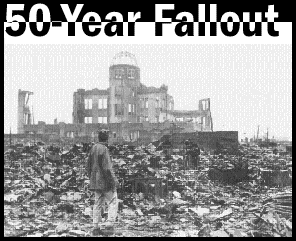
UPI/Bettmann
August 1945: The bomb that leveled
Hiroshima kicked off a costly nuclear
arms race that corrupted international
relations for decades to come.
By G. Pascal Zachary
Hiroshima marked the opening act of a grim, expensive Cold War that for decades defined America's relations to the rest of the world and sapped its national spirit.
On Aug. 6, 1945, a lone B-29 airplane destroyed 60 percent of Hiroshima with a single atomic bomb, killing nearly 100,000 Japanese civilians. Fifty years later, the United States remains the only nation to have ever used nuclear weapons in war. The question of why is passionately debated today by those who see Hiroshima as a symbol of American immorality.
But just what kind of symbol isn't always clear. "Americans continue to experience pride, pain, and confusion over the use of the atomic bomb against Japan," Robert Jay Lifton and Greg Mitchell write in Hiroshima in America, a perceptive new history of American responses to the bombing over the past half-century. "Part of each of us wishes to believe that the decision to use the bomb was reasonable, but another part remains uncomfortable with what we did."
Even at this late date, the battle over the collective memory of Hiroshima and Nagasaki (bombed three days later, on Aug. 9, 1945) matters greatly. Those who defend the bombing cite it as justification for brandishing our nuclear arsenal today. Those who view Hiroshima as the most shameful event in our nation's history see the U.S. as a nuclear bully whose still vast arsenal worsens the prospects for world peace.
Further Reading
It is all too easy to leave unresolved our thinking about the bomb. Yet it is important that we make up our minds, a notion that will probably not garner much consideration next month, when many Americans will unapologetically celebrate the 50th anniversary of the atomic bombings. To condemn the atomic bombings of Hiroshima and Nagasaki should in no way limit our comprehension of the decision to bomb these cities. To explain the bombings doesn't explain them away; it doesn't excuse these deplorable actions. We can't undo history, of course, but we can influence the future. How we think about Hiroshima today will determine how we think--and act--about the next use of nuclear weapons.
And we may face another Hiroshima sooner than we think. For decades, the U.S. has threatened its enemies, from Vietnam to Iraq and North Korea, with nuclear obliteration. There's always a chance a rogue nation may push the U.S. too far. Or a terrorist gang might explode a stolen nuclear bomb, raising the issue of the proper U.S. response.
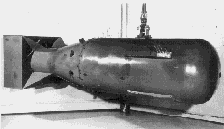
UPI/BettmannHot Spark of Cold War Boys: This "Little Boy" bomb is the same type that was detonated over Hiroshima.
Easy Way OutIn rethinking the bomb, it's important to give the nuclear proponents their due. The destruction of Hiroshima brought World War II to a swift close, prompting Japan to abandon plans for an all-out defense of its land and hastening its unconditional surrender. And by the grim standards of that war, the most murderous episode in human history, the bombings weren't especially horrible. The incendiary bombing of Tokyo in March 1945, for instance, killed more people than the Nagasaki bomb.
But the very banality of Hiroshima's evil is a weak defense, so proponents justify the mass killing of Japanese civilians by citing simple retribution for Japan's own horrid acts. As critics of the Smithsonian Institution's doomed Enola Gay exhibit loudly proclaimed, the Japanese were terribly cruel in conquering parts of China in the 1930s. They also drew the U.S. into World War II with a surprise attack on Pearl Harbor in December 1941.
Finally, the Hiroshima-niks argue that the Japanese only have their own leaders to blame for the atomic rain. Indeed, had Japan surrendered in early 1945--or at least after the bloody loss of Okinawa in June, which made defense of the home islands a long-term impossibility--it would have robbed the U.S. of any chance to use atomic bombs, which weren't even tested until July 1945. So disdainful of their people were Japan's leaders that they preferred the face-saving excuse of annihilation to the prospect of an effective anti-war, anti-military movement at home.
As one Japanese leader wrote a few days after Nagasaki's destruction, "I think the term is perhaps inappropriate, but the atomic bombs ... are, in a sense, gifts from the gods. This way we don't have to say that we have quit the war because of domestic circumstances."
The craven disregard for its citizenry by Japan's ruling elite provided a convenient excuse for dropping atomic bombs on Hiroshima and Nagasaki. Indeed, it informed President Truman's own rationale for dropping the bomb, stated bluntly in a letter to theologians soon after the attacks: "The only language they [the Japanese] seem to understand is the one we have been using to bombard them," wrote the only president to have ordered a nuclear assault. "When you have to deal with a beast you have to treat him as a beast."
To the believers in the inevitability of Hiroshima, the Japanese were the enemy, a force to be destroyed, and nothing more. To these atomic believers, there is no painful paradox in fighting evil with evil; U.S. motives were pure, even when its actions weren't. Moreover, the atomic bombings had a good side: to wit, the saving of an untold number of American lives, which would have been lost in an invasion of Japan. Realistic estimates put the number of deaths at under 25,000, well below the popular yet unfounded figure of 500,000, but still an awful toll. Because an invasion was avoided, the atomic believers ask us not only to accept the bomb but love it too.
Or as essayist Paul Fussell once wrote, Americans should "thank god for the atom bomb."
This is stupidity on a grand scale. This is patriotism run amok. That both the invasion of Japan and the imagined casualties could have been avoided--by a combination of alternative military and diplomatic tactics--is conveniently ignored by these myth-makers.
One compelling scenario: A U.S. naval blockade of Japan, supported by continued conventional bombing and the willingness to allow Emperor Hirohito to retain his throne, would likely have led to Japan's surrender before Nov. 1, the date of the planned invasion. Allowing the emperor to retain a symbolic role in Japanese affairs, in the end the lone condition insisted upon by Japan, was ultimately agreed to by the U.S. after the war, though it was flatly rejected during the war.
Russia's declaration of war against Japan, which was issued between the Hiroshima and Nagasaki bombings, also might have prompted Japan's surrender, even in the absence of an atomic attack. Japanese records indicate that the country's leaders were perhaps more shaken by Russia's actions than by the two atomic bombs.
While it is impossible to prove the inevitability of that which never happened, there is every reason to conclude that all of these factors, taken together, would have forced Japan to capitulate. As Barton J. Bernstein, a leading scholar of the atomic age, writes in the current issue of Diplomatic History, "There was, then, more probably than not, a missed opportunity to end the war [with Japan] without the A-bomb and without the November invasion."
To be sure, defenders of Hiroshima will insist that this is pure speculation. Yet they have a harder job dismissing the terrible cost of Hiroshima for succeeding generations. It is a cost we are still very much bearing.
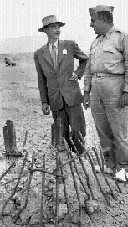
UPI/BettmannTwisted Legacy: Maj. Gen. Leslie R. Groves (right) and Los Alamos project director J. R. Oppenheimer survey the remains of the steel tower that bore the first atomic bomb, tested near Alamogordo in July.
The Price of Victory
Let us tally the burden of dropping the bomb. To start with, Hiroshima marked the opening act of a grim, expensive Cold War that for decades defined America's relations to the rest of the world and sapped its national spirit. Much of the enthusiasm for Hiroshima, among U.S. political leaders, was its perceived value in convincing the Soviet Union that we meant business. With the "bomb in our hip pocket," to paraphrase Truman's secretary of state, the U.S. could bully the Soviets into staying on their side of Europe.
The price of impressing the Russians, of course, was a spiraling arms race. Even before Hiroshima, a few of the Americans who knew of the bomb's existence privately warned of the dangers of unleashing this genie. Vannevar Bush, organizer of the Manhattan Project and President Roosevelt's science adviser, pointedly predicted in late 1944 that Russia and other industrial powers could build their own atomic weapons, perhaps in as little as a few years' time. Perversely, these rivals would be aided by the very demonstration by the U.S. of the bomb's feasibility.
Bush and his aide, Harvard University president James Conant, recommended the creation of an international organization to regulate atomic technology and forestall a race for supremacy in nuclear weapons. The proliferation of weapons had dogged human civilization for centuries, but nuclear arms marked a radically different chapter in the sorry history of war, the two scientists believed. Machine guns killed dozens of men at once, but only those unlucky enough to get in the gun's path. Airplanes sowed terror, but with ample warning civilians found refuge in underground shelters. But there was no hiding from atomic bombs, which for the first time in history inflicted mass destruction on their targets.
We are so familiar with the image of the mushroom cloud and the possibility of nuclear annihilation of the planet that it is hard to appreciate the shock to familiar ways of thinking engendered by the first use of the bomb. Against the backdrop of the carnage of the war, the devastation of Hiroshima might seem almost unremarkable. But even with their senses dulled by the deaths of millions of civilians, contemporaries immediately saw the use of the atomic bomb as a watershed in history.
The day after hearing the news, the philosopher and writer Albert Camus wrote in the French newspaper Combat that: "[O]ur technical civilization has just reached its greatest level of savagery. We will have to choose, in the more or less near future, between collective suicide and the intelligent use of our scientific conquests."
"Even before the bomb," Camus added, "one did not breathe too easily in this tortured world. Now we are given a new source of anguish; it has all the promise of being our greatest anguish ever. There can be no doubt that humanity is being offered its last chance."
Despite many intellectuals' preoccupation with the devastating implications of the bomb, politics went on as usual. Proponents of world government seized the opportunity to press their case. Bush and Conant, who knew enough about atomic science to realize that there was no "secret" to protect, urged that the U.S. share its knowledge of the atomic bomb with Russia and other nations in exchange for their promise not to develop atomic weapons themselves. Their advice to President Truman went unheeded, but their prediction of a nuclear arms race proved chillingly correct.
Four years after Hiroshima, Russia detonated its first atomic bomb. The U.S. countered with the far more destructive hydrogen bomb, which the Russians quickly matched. The British developed their own bombs, with little U.S. help. Later the French and Chinese went nuclear. By the 1980s, the Indians, the Pakistanis, the Israelis and the South Africans were poised to join the "nuclear club." Today, several nations are trying to add nuclear weapons to their arsenals, including Iraq, Syria and perhaps North Korea.
Surrender to SecrecyThe Cold War and the ongoing prospect of nuclear war have taken a cumulative toll over the past 50 years. Yet immediately following World War II, even some of America's top military men saw the bomb in a different light.
"My own feeling was that in being the first to use [the bomb], we had adopted an ethical standard common to the barbarians of the Middle Ages," wrote William Leahy, chairman of the august Joint Chiefs of Staff.
Dwight Eisenhower, who led the D-Day invasion that took back Europe from the Germans, told his civilian masters that the bomb itself was "unnecessary," and "no longer mandatory [even] as a measure to save American lives."
Why these war heroes were ignored is best understood by examining the most insidious effect of the atomic age: the rise of a secret government and the mortal wounding of the American democracy.
To understand how the Manhattan Project and the decision to use the bomb on Hiroshima became the model for a government run by experts and not the people, we must return again to the summer of 1945. By then, any pretense that Americans hewed to a higher standard of morality in war had vanished. For months the Air Force had relentlessly bombed Japanese cities. Indeed, the U.S. was leveling so many "targets" in Japan that military planners actually feared they would run out of them before the war officially ended.
The dwindling number of targets lent a perverse quality to the final push to ready a few atomic bombs for use. In mid-June, a month before the successful "Trinity" explosion in the desert of New Mexico, John J. McCloy, who served on a secret committee that approved the bomb's use without warning, complained that "there were no more [Japanese] cities to bomb, no more carriers to sink or battleships to shell." The implication was obvious: Maybe the bomb wasn't needed at all.
But there was no stopping the atomic bomb by then. The Manhattan Project, originally charged with building a bomb before the Nazis did, had taken on a life of its own. As it turned out, German efforts to build a bomb amounted to almost nothing, and the Japanese never even took even the first steps toward doing so. Yet still the leaders of the Manhattan Project were frantic to finish their job.
"If we had not completed the bomb [before Japan's surrender] there was a possibility that funds would have been cut off, that there'd have been great questions raised" by the public and that the entire project might have been scrapped, Vannevar Bush later recalled.
Bush had good reasons for fearing the public's reaction to learning about the Manhattan Project. Perhaps he alone fully appreciated the way in which the Manhattan Project contradicted the nation's democratic principles. Billions of dollars in public monies poured into the project without explicit congressional approval or oversight. No public debate occurred over the propriety of using the bomb--or the potential consequences, which even Bush believed included a terrifying arms race that could consume humankind. Not even the decision to build the bomb was publicly discussed.
In making and using atomic bombs, a handful of experts--shielded by the crisis of war--usurped the people's rightful power to govern themselves in matters of the greatest moment. This is perhaps the most important legacy of World War II. After the war, a whole array of agencies sprung up behind a wall of secrecy. Much like the Manhattan Project, the Central Intelligence Agency and the National Security Agency hid their budgets and their activities even from Congress. The Atomic Energy Commission, charged with building bombs, secretly laid waste to dozens of American towns and irrationally promoted inherently expensive nuclear power, terming it "too cheap to meter." Perhaps most shockingly, the government even performed radiation experiments on unsuspecting citizens.
No one considered how this betrayal of democracy might come to haunt America. The Manhattan Project was a brilliant success, after all. Public interference only mucked things up. The CIA, the AEC the NSA and the rest of the secret agencies shared the fantasy that their experts knew best.
We have since learned otherwise. The Aldrich Ames case, in which the CIA allowed a bungling spy to gut its Russian operations, is only the latest reminder of the bankruptcy of the expert class.
These technocrats, even at their best, are no substitute for broad participation of the citizenry in the big decisions of a democracy. In approving the use of the bomb against Japan, Truman ratified the new technocratic order, handing the ultimate authority over American life to an unelected elite. In the end, this was as big a tragedy as the destruction of Hiroshima itself.
Disarming NotionsDespite the end of the Cold War (and in some ways because of it), nuclear arms proliferation even now darkens the human prospect. While the U.S. and the former Soviet Union have reduced their arsenals, the "nuclear club" is undiminished. Only South Africa, in an inspired act of leadership that deserves the world's attention, has destroyed all of its nuclear weapons and the capabilities of making new bombs.
No country has followed the lead of Nelson Mandela's government. China continues to test and build nuclear bombs. France plans new tests later this year. Russia leaks both bomb-grade plutonium and nuclear experts onto the black market, while it struggles to control its missiles. The Ukraine, which inherited a nuclear arsenal on the breakup of the Soviet Union, has pledged to disarm but has yet to do so.
As for the U.S., the signs are hopeful. Our country's nuclear-arms factories are more intent on disassembling bombs than adding to the stockpile. Churches have turned missile silos into sanctuaries. The underground nuclear test site in Nevada lies silent. And the ranks of weapons designers are thinning at the Los Alamos, New Mexico and Livermore bomb labs.
But the ghost of Hiroshima still looms. While the Clinton administration sticks to a ban on testing, rogue weapons designers and their military patrons argue for a resumption of "small" explosions aimed at honing nuclear expertise.
President Clinton has wisely resisted the temptation to mollify the nuclear-arms complex. Renewed testing by the U.S. would doom any chance of a global ban on nuclear explosions.
The U.S. could do more, though. The country's reliance on nuclear weapons as the ultimate means of ensuring military superiority sets an awful example for the rest of the world. Why should smaller, less powerful nations, even so-called rogue states such as Iran and Iraq, shun nuclear arms when U.S. military hegemony rests on these very weapons?
The 50th anniversary of Hiroshima is a fitting time for the U.S. to finally forswear the first use of nuclear weapons against another nation, regardless of the provocation. Only by vowing to never again be the first to use nuclear weapons in war will the U.S. both expiate the sin of Hiroshima and set the world on a course toward nuclear disarmament.
While giving up the nuclear option would weaken the U.S. militarily, the risks of doing otherwise are too great. As the journal Foreign Policy recently noted, "America's continued reliance on nuclear weapons cripples its efforts to persuade others not to seek nuclear capabilities."
G. Pascal Zachary is the former editor of the San Jose Business Journal and the author of a recent book about Microsoft, Showstopper.

This page was designed and created by the Boulevards team.
Copyright © 1995 Metro Publishing and Virtual Valley, Inc.