























home | metro silicon valley index | the arts | visual arts | book review
Above and Below
Two new books explore the multitudes underwater and on land
By Michael S. Gant
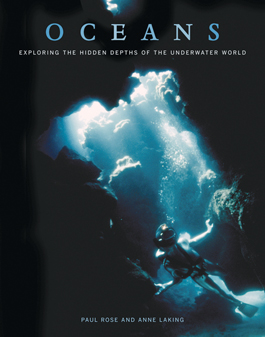
WE RARELY think about the obvious, unless we have a window seat on a long trans-Pacific flight: "Four-fifths of all life on earth is found below the waves," write Paul Rose and Anne Laking, co-authors of Oceans: Exploring the Hidden Depths of the Underwater World. That large fraction beckoned a crew of underwater explorers to undertake eight expeditions. The book, which was prepared along with a BBC nature series, covers the results of their labors in the Mediterranean, the Atlantic Ocean, the Sea of Cortez, the Indian Ocean, the Red Sea, the Southern Ocean (around the South Pole) and the Arctic Ocean. Each chapter begins with some historical and environmental background, but the real meat comes when the intrepid divers penetrate depths never before surveyed or come in close contact with predators like the rarely seen sixgill shark.
Some of the most thrilling moments occur when the divers go deep into sea caves, overcoming two primal fears: drowning and entombment. Ascending from Dan's Cave on the Bahamian island of Abaco requires hanging 6 meters below the surface in zero visibility to avoid nitrogen build-up. Perhaps the most amazing stop on this global journey is the Black Hole near Cuba—a sinkhole that drops straight through some sedimentary limestone, forming an isolated deep pool. The dive required plunging through a dense layer of microbes almost "psychedelic red-purple" in color.
The photographs are as compelling as a landlubber has a right to expect. A spectral manta ray glides like a phantom through a school of brightly colored small fish. A dwarfed diver circles around a pod of closely packed "socializing" sperm whales. A very crabby creature, known as a hand fish because its fins look eerily like human appendages, glares balefully at the camera man. In addition to the spirit of adventure, Oceans also makes some sobering points about the degradation of the natural aqueous world, from the endangered blue-fin tuna and beluga whales to the overall retreat of the polar ice caps due to climate change. (By Paul Rose and Anne Laking ; University of California Press; 200 pages; $34.95 hardback)
What Oceans does for the aquatic world, the even larger Illustrated Atlas of Wildlife does for the beasts that crawl, run and fly. This multi-author, profusely illustrated reference volume covers the continents, the poles and, again, the oceans. Two-page spreads are devoted to various ecosystems—flyways, forests, islands, etc.—with photographs, detailed drawings, graphs and maps.
Discoveries abound on every page. Who knew about the round-maned raccoon dog of the deciduous woodlands of Europe? A route map shows the amazing lengths to which birds will go to forage and mate—the blue-and-orange-hooded Hurndo rustica swallow, all of 13 inches long, migrates some 5,600 miles. The maned wolf of South America's Gran Chaco region has stiltlike legs that allow it to maneuver through tall grass; sadly, only 1,500 still exist in the wild due to habitat loss. Probably only another solenodon could love the rat-size Cuban rodent with a long bristle-covered snout; it is reported to be one of the few mammals with a poisonous bite.
A detailed taxonomy section provides specific information on thousands of species. This is the kind of coffee-table reference book that elicits hours of informative browsing. One puts it down both exhilarated by the profusion that evolution has produced and sobered by the knowledge that so much of it is in danger of extinction. (By Channa Bambaradeniya, Cinthya Flores et al.; University of California Press/Weldon Owen Group; 288 pages; $39.95 hardback)
Send a letter to the editor about this story.
 |
 |
 |
 |
 |