
Suicide Squeeze
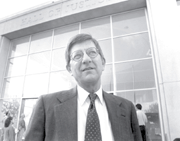
Bad News Bearers: Santa Clara County Assistant District Attorney Tom Fahrenholz said the state Supreme Court ruling giving judges discretionary sentencing power in "third-strike" cases doesn't have prosecutors jumping for joy, but things could definitely be worse.
While prosecutors balk at judges' authority in 'third-strike' cases, a law-and-order movement that threatens to strip power from both parties is warming up in the bullpen
By Vince Bielski
LAST WEEK, the state Supreme Court sent a slim ray of hope into the prison cell of Edward Brannum. Brannum figured he'd be an old man before his 25-years-to-life sentence under "three strikes and you're out" was up. The heroin addict's third strike was stealing a blanket and some costume jewelry from Macy's at Valley Fair. At the time of sentencing, even Santa Clara Superior Court Judge David Leahy was uncomfortable as he sent the 38-year-old into the abyss of the third strike. "I don't believe that this type of sentence is in any way necessary based upon the offense before me," he said in 1994. But Judge Leahy wasn't sure he had the authority to reduce the harsh prison sentence, so he reluctantly imposed it.
On June 20, the state Supreme Court cleared up the confusion in no uncertain terms. The justices unanimously ruled that their brethren in lower courts are not mere court clerks with no power over sentencing in three-strikes cases. They are judges who must exercise their authority--in the interest of justice--so the prison time will fit the crime.
The ruling set off near-pandemonium among the law's right-wing boosters, who immediately began propagating the myth that the 15,000 "three-strikers" now in state prison may walk free. Within hours of the ruling, they proposed that newer and harsher legislation would be required. The press further indulged the fantasy with stories like the one in the San Francisco Examiner: "3 strikes ruling rattles system--Court's crippling of law ..." or the San Jose Mercury's banner headline: "Ruling cripples '3 strikes.' "
The law, say attorneys who are angry over the media coverage, hasn't been crippled at all. "The headlines have not been accurate. The ruling won't have a huge impact," said Dallas Sacher, senior staff attorney at the Sixth District Appellate Program, a nonprofit which handles appeals of three-strikes convictions out of Santa Clara. "It just restores discretion which judges traditionally had. There will still be a lot of defendants getting long sentences. But from time to time, a judge might exercise discretion."
In the wake of the ruling, Brannum and most of those convicted under Three Strikes probably will ask judges to reconsider their sentences. However, like the local prosecutors who have come down hard on third-strikers, the black robes of Santa Clara are hardly pushovers. "Santa Clara judges have the reputation of being the toughest in the Bay Area," said San Jose defense attorney Tom Kelley.
Fenced In: Local prosecutors have used Three Strikes aggressively, and judges are expected to be equally tough.
ARE THEY SO STERN that even the strongest of appeals--such as those from nonviolent convicts like Brannum--will be denied?
Brannum says on the day of his fateful third strike, his troubles all began with a domestic spat with his girlfriend. Hoping to patch things up, he took off to Macy's to buy her a card. On the way, he lapsed and turned to his old habit--heroin--to settle his nerves.
Once inside Macy's, Brannum says, he became upset with himself for shooting up while trying to quit. He had been clean for months. He also had repeatedly tried to get himself into a crowded methadone clinic in Morgan Hill and was turned down. Figuring that the best way to get treatment for his addiction was to go to jail, Brannum says, he stole the goods in front of a video camera and security guard, hoping to get caught. He got his wish. The guard followed him out of the store and nabbed him in the parking lot.
The Santa Clara district attorney's office took one look at Brannum's priors and threw the book at him. In 1988, during a peak in his addiction, Brannum robbed five small stores in seven days. He had carried a knife during the robberies, but no one was harmed. Since then, he hadn't committed any other felonies. But the priors gave prosecutors the two strikes they needed to charge Brannum with his third. Under the law, the third felony doesn't have to be serious or violent; almost any crime will do.
The 1994 case angered deputy public defender Ruben Espinosa, who didn't think California voters had drug addicts like Brannum in mind when they approved the initiative earlier that year. At the trial, Brannum's parole officer and jail staffers came to his defense, testifying he had been a model prisoner and parolee. "He didn't just do well. On his own, he encouraged other inmates to get rehabilitation," Espinosa said. "He said, 'Look at what happened to me, don't let this happen to you.' "
Cases like Brannum's--whose appeal prospects brighten under the new ruling--may soon pour into local courts. During the reign of Three Strikes, the Santa Clara County District Attorney's office has been notorious for zealous enforcement of the measure. "Santa Clara isn't what we call the most enlightened county. I try to avoid doing three-strike cases there," said Kelley, who practices in both Santa Clara and San Mateo courts. "I had one case in Santa Clara where a guy was accused of breaking a window and trying to steal a weed whacker. He was found guilty and now faces 25 to life."
The ongoing controversy over the law boils down to what should be done when the third strike isn't a serious or violent crime. (Few argue when the law is applied to murder, assault and other serious crimes.) Under Santa Clara District Attorney George Kennedy, prosecutors use the severe law about 33 percent of the time when the third strike is a minor crime, said prosecutor Tom Fahrenholz.
Far fewer cases have been pursued in surrounding counties. San Mateo District Attorney James Fox, for example, puts the figure at about 15 percent for his county. Alameda prosecutor Bill Baldwin said, "I'd be amazed if we prosecuted as many as 15 percent." In San Francisco, virtually no such cases are pursued. One has to look far to the south, in Orange County, to find a place where more aggressive use of Three Strikes has been employed. "We go by the book," said Orange County prosecutor Sean Stafford before reciting the long penal code number of the three-strikes law. "I'm sure we prosecute more than 33 percent."
IN THEORY, California law is supposed to be applied equally to everyone in the state. But Three Strikes has endured as one of the most political laws on the books, born in the public panic surrounding the brutal kidnapping and slaying of Polly Klaas. When the initiative was put before voters, Fox said, they didn't understand the law could be applied to minor third crimes.
Lawmakers in Sacramento could have clarified the picture for voters by placing a competing measure on the ballot requiring the third crime be serious. "I blame the politicians for pandering to the fears of voters and not giving them the choice so there would be no confusion that we are taking the violent offenders off the street," Fox said.
Politics is also the reason enforcement of the law has varied so widely among different counties. In the left-coast city of San Francisco, where voters elected progressive former defense attorney Terence Hallinan to sit in the DA's chair, a policy not to pursue three-strike convictions for nonviolent offenders has been enforced. In conservative Orange County, prosecutors boast about the number of three-strike convictions under their belts.
The 1994 initiative gathered 64 percent of the vote in Santa Clara County. Regardless of personal opinions and beliefs within the DA's office (District Attorney George Kennedy opposed the initiative before the election), prosecutors have adhered to the spirit of the law. "We have a duty to implement the law in a way that our electorate approves of and in a fashion our juries agree with," said Fahrenholz, who speaks for the DA's office on these matters.
Among the small-time crimes that Kennedy's office has charged under Three Strikes: petty theft with a prior, pimping, driving under the influence, failing to register as a sex offender when changing addresses, and possession of a small amount of drugs for personal use. "It's so depressing," says Javier Rios, a deputy public defender in Santa Clara. "In this office we can find a way to use gallows humor with most kinds of cases, but no one makes jokes about three-strike cases. Everyone feels so bad about it. If you would have told me a few years ago it was possible for a guy to get 25 years to life for a DUI, I would have said, 'What planet are you from?' Now it's happening."
UNTIL THE state Supreme Court ruling, prosecutors were the only ones with the power to decide whether to pursue a third-strike conviction. The law has always been clear on the point that prosecutors can ignore a prior conviction as a way to sidestep the 25-years-to-life sentence. But the law did not explicitly state that judges could do the same thing. The state Supreme Court, citing a democratic society's need to maintain a balance of powers, declared that if prosecutors have the authority, judges must have it too. To some degree, prosecutors reveled in their authority and now regret they have to share power with judges. "We would prefer to have it the way it's been," Fahrenholz said.
The fine-tuning by the court makes Three Strikes a more just law. It will serve as a check on overly aggressive prosecutors, who might think twice before using the law against small-time felons like Ed Brannum.
"Even if they get a conviction, the judge could strike a prior after the trial," Sacher said. "So in some cases, prosecutors may not want to spend all the time and money going to trial if they could get the same result with a plea bargain."
But the checks and balances of democracy aren't foremost on the minds of right-wing lawmakers in Sacramento, led by Sen. Rob Hurtt of Garden Grove and backed by Gov. Pete Wilson. They are vowing to strip judges of the power they just received, either through a constitutional amendment or a bill, which would remove discretion over sentencing from both judges and prosecutors. It's a blatantly political move in an election year, filled with fear-mongering about crime, and has alienated prosecutors who know the importance of keeping some flexibility in the very imperfect criminal justice system.
"There has to be some discretion in the system somewhere," commented Fahrenholz. "There are not widgets. There are people's lives and behavior that we are looking at. No two cases are the same. It doesn't lend itself to a production mentality."
[ Metro | Metroactive Central | Archives ]
This page was designed and created by the Boulevards team.
Christopher Gardner
Christopher Gardner
From the June 27-July 3, 1996 issue of Metro
Copyright © 1996 Metro Publishing and Virtual Valley, Inc.