
Feathered Frenzy
Arcane new regulations to benefit developers could threaten the population of burrowing owl and hundreds of other species on the edge
By Richard Sine
FOR YEARS Lynne Trulio has watched the decline of the burrowing owl in Santa Clara County. The nine-inch bird of prey hides its young in abandoned squirrel burrows and hunts for insects, lizards and mice. It is the only kind of owl that lives and nests underground. Unfortunately, burrowing owls require the same kind of flat, grassy land that developers love. Trulio estimates that only 9,000 pairs of burrowing owls remain in the state, their habitat declining by more than half in the last ten years. Out of an original population which numbered in the thousands, about 170 pairs remain in the South Bay.
Trulio, an assistant professor at San Jose State, has been creating artificial burrows and recommending strategies to try to save the remaining birds nested on land slated for development. But she is worried that some arcane new bureaucratic guidelines--led by California Governor Pete Wilson--may bury the owl for good. "It's hard enough to convince a city or a developer to do anything at all to mitigate the effects of a development's impact. Without any teeth saying you've got to do something, they won't do anything. I don't want the species to become endangered or theatened, because by that time there's hardly any left."
Environmental groups have unearthed a spate of recent bureaucratic maneuvers that they feel could endanger not only the owl, but also over 200 other wildlife species and 900 plant species whose numbers are documented to be in decline. Currently these species can find some shelter under the California Environmental Quality Act, or CEQA. But proposed changes to CEQA guidelines threaten to leave them high and dry.
State officials say the new guidelines simply clarify existing law. But environmentalists believe that Wilson, who has failed to push through legislation that would nearly extinguish the state's Endangered Species Act, is now trying to end-run the Legislature through such steps as rewriting regulations and appointing anti-environmentalists to the state Fish and Game Commission.
The day Metro hits the streets, Craig Breon of the Santa Clara County Audubon Society will join environmentalists from around the state to testify against the new guidelines in Sacramento. "Pete Wilson is working every angle he can to attack the state's wildlife," Breon says. "This is just one of his quieter approaches."
Home Sweet Hole: Birdwatcher-turned-activist Les Chibana points out a squirrel hole formerly used as a nest by burrowing owls.
UNDER CEQA, signed into law on the heels of the first Earth Day in 1970, local governments faced with a proposed development are required to survey potential environmental impacts including noise, traffic and damage to wildlife. If the government finds that the impacts will be "significant," it can order the developer to conduct a detailed (and often expensive) environmental impact review and alleviate some of the harmful effects of the development.
In some circumstances local governments are required to order such a review, such as when a development threatens a species on the endangered or threatened list. But it must also occur when it threatens a species that "may become endangered if its environment worsens" or is "likely to become endangered within the foreseeable future throughout all or a significant portion of its range."
The new, developer-friendly guidelines would strike out these last provisions and require review only for species already listed as threatened or endangered. "A lead agency could not determine that the project would have a significant impact on a species if that species was not listed under the State or Federal act," reads a "Statement of Reasons" that accompanies the proposed guidelines.
Enter the burrowing owl, the golden eagle, the coho salmon, the mountain beaver and hundreds of other species on the state's list of "Special Concern." These species are not listed as threatened or endangered, but the state Department of Fish and Game has evidence that these species are declining or losing habitat. They could be rare or even extinct in some regions of the state. There are many more Species of Special Concern than threatened or endangered species.
Environmentalists believe the new guidelines will leave it up to local government bodies whether or not to require an environmental impact report for sites containing these species. Worse, they fear local governments may let developers off the hook for any efforts to preserve them.
"Wilson's top priority is to get rid of CEQA, which is the number- one symbol of the ability to make a business or new development slow down and pay attention to things other than money," says Gary Patton, a lobbyist for the Planning and Conservation League. "It's the most powerful way an ordinary citizen can make the government pay attention to things they'd rather turn a blind eye to."
The state Resources Agency, charged with revising the CEQA guidelines every two years, claims the proposed guidelines came not from Gov. Wilson but from their own internal review. Andy McLeod, deputy secretary of the agency, says the agency doesn't intend to change the environmental coverage provided by CEQA and could be convinced to change the guidelines by the public comments from environmentalists and other concerned groups.
McLeod justifies the new guidelines by saying that "biological professionals should make the decisions" about whether a species is truly threatened. He adds that local agencies could still order full environmental reviews when no endangered species are on the site, but "to provide that there be mandatory CEQA compliance runs counter to the expertise brought to the process by Fish and Wildlife and Fish and Game."
But at least in the case of the state's endangered species act, biological professionals are not making the final decisions about whether species are threatened. Instead, the Fish and Game Commission is filled by five governor's appointees, most of whom have little experience in biology. The commission has come under attack for slowing the numbers of species they list to a trickle in recent years. Only two animals and two plants have been listed since January 1994. Currently the commission is fighting a suit demanding a place on the list for the Sacramento River spring run chinook salmon.
Ron Telzman, assistant executive director of the Fish and Game Commission, defends the board's record. He points out that in the commission's ten years in existence it has listed 55 of the 68 species for which petitions were filed. The conservation groups respond that, given the board's current makeup, it is no longer even worth their trouble to file petitions.
Seldom-Spotted Owl: Les Chibana and other environmentalists keep a close eye on the burrowing owl, listed as a species of special concern in California--a designation that indicates the bird's numbers may be declining.
IT'S TOO early to tell what effect these regulations will have if they pass. They are likely to face an immediate challenge in court from several environmental groups, which claim they go against the intention of CEQA. The Act requires agencies to consider a development's impact on all wildlife species, whether endangered or not.
In the meanwhile, conscientious city councils and environmental consultants may heed the thrust of CEQA and go about business as usual. "I'm not a lawyer, but as I look it, I don't think it's going to amount to any great changes," says Rick Hopkins, a San Jose wildlife biologist who evaluates proposed developments. "CEQA evolves with legal challenges and the judges' rulings that come from them. But as a biologist I'm supposed to look at all species on site whether they're common or not."
For city councils eager for the tax dollars that accompany new development, however, the new regulations could someday provide just the excuse they need to overlook a few pesky nests in the ground.
"CEQA provided one of the few tools that we have to protect a rare species not listed as endangered or threatened, to mitigate the impacts of development," says Lynne Trulio, the San Jose State biologist. "It hasn't worked incredibly well, and with these changes we won't even have that."
[ Metro | Metroactive Central | Archives ]
This page was designed and created by the Boulevards team.
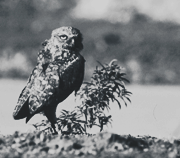
Owl Be Damned: The valley's burrowing owl population has dropped to just 170 pairs because development has encroached on the bird's flatland habitat.

Robert Scheer
Robert Scheer
From the July 25-31, 1996 issue of Metro
Copyright © 1996 Metro Publishing and Virtual Valley, Inc.