























home | metro silicon valley index | music & nightlife | band review
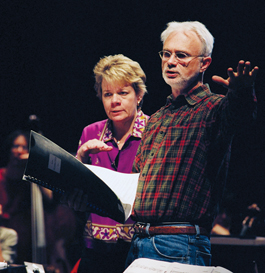
Photograph by R.R. Jones
TEAMWORK: Collaborators John Adams and Marin Alsop (seen in 2004) hooked up again this year.
Into Orbit
Cabrillo Festival earned an ovation for West Coast premiere of John Adam's abstract 'Doctor Atomic' Symphony
By Scott MacClelland
JOHN ADAMS' Doctor Atomi Symphony, in its West Coast premiere at the Cabrillo Festival of Contemporary Music on Saturday night, revealed the difficulties the composer had previously admitted in making a symphonic synthesis from his opera of the same name. At times, it was plainly representational, with trombone and trumpet solos standing in for the characters of Gen. Leslie Groves and Robert Oppenheimer, respectively. But most of its 25 minutes remained both abstract and hard to track, notwithstanding a vivacious orchestral palette and wide range of sonic effects (including a theremin solo "played" by the orchestra's librarian).
The trick to making music coherent, and specifically memorable, is form, something with which Adams has usually run far ahead of the pack. But here, even with his written description in advance, the sound and fury didn't bring their purpose into clear focus, as the opera itself had in San Francisco in 2006. The Finnish composer Einojuhani Rautavaara achieved more success, in 1992, translating his opera about Vincent van Gogh into a symphony, Vincentiana, not least by limiting the four discrete movements (Starry Night, Crows, Saint-Rémy and Apotheosis) to their operatic contexts—more or less—and where a certain madness was expected anyway. Had Adams done something similar, he probably would have gotten a longer and more satisfying work out of it. Nevertheless, the Cabrillo audience gave the orchestra's spectacular performance a standing O, and the composer's historic love affair with Cabrillo and conductor Marin Alsop meant hugs for the instrumental soloists and Marin herself.
The program opened with Sneak in a Window by 19-year-old Matthew Cmiel, a pupil of Adams and Jennifer Higdon, blistering every section of the orchestra with serious heat, in multirhythmic, multistyle complexity that boggled the mind with sizzling musical urgency. In seven minutes, it gushered imagination and invention that the composer later admitted to me was largely a matter of "luck." The orchestra's principal clarinetist, Bharat Chandra, starred in Mark Anthony Turnage's Riffs and Refrains, more memorable as a solo vehicle, with jazzy big band references, than for musical content. John Corigliano's Mannheim Rocketis a splendid orchestral cartoon that programmatically references the history of German music from the 18th century to the present and back again.
This programmatic eclecticism infused Sunday's San Juan Bautista Mission program in Chiayu's Feng Nian Ji (Harvest Festival) and Alla Borzova's To the New World. (Indeed, most of Main Alsop's programming this summer was about eclectic sampling and/or orchestration more than expressive content per se.) The brief concert—less than one hour of music—opened with Cabrillo composer's workshop alum Chiayu's programmatic portrait of life among Taiwan's matriarchal, indigenous culture, cleverly using the old call-and-response technique as dialogue between fast and slow sections. Borzova's crafty travelogue sampled stereotypic Irish, German, Austrian, klezmer, Italian, African, Latin American, Chinese and jazz music. Avner Dorman's Variations Without a Theme was, by contrast, internally eclectic, relying on specific intervals and mottos for its many permutations. All the above made hay with the orchestra's extravagant resources and, under Alsop's sparkling authority, kicked butt.
San Francisco.com Real Estate
Moving to the Bay Area just became easy. Let San Francisco.com show you all the homes currently for sale.
San Jose.com Real Estate
Relocating to San Jose or Silicon Valley? Let San Jose.com introduce you to some expert area real estate agents.
Only the strings were engaged by Last Round, Osvaldo Golijov's memorial homage to "the last great tango composer," Astor Piazzolla. Originally scored for two string quartets and double bass, it seeks to imitate the sound of Piazzolla's bandoneón, its first movement representing "violent compression of the instrument," the second, an "endless sigh." Golijov himself could be the next great tango composer, though he has already demonstrated a far wider range of styles. In any event, he should be among the festival's next stable of composers-in-residence.
Send a letter to the editor about this story.
 |
 |
 |
 |
 |